
Off-Road Vehicle Dealer
Digital Marketing.
The dealer already has the inventory and a build shop — neither is reaching the buyer searching for a trail-ready truck. This is not a generic dealer playbook. OEM co-op doesn't exist for your service bay.
Off-Road Vehicle Dealer Marketing
Doesn't Start at the Lot.
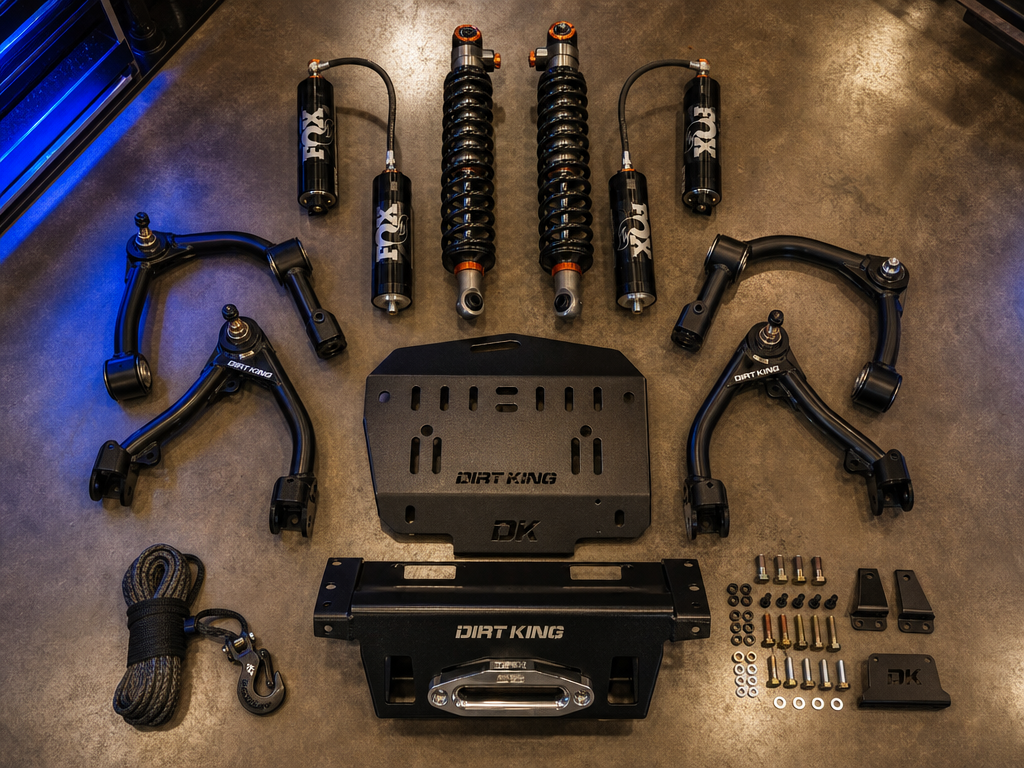
Your dealership has something most 4x4 specialty shops would never have — a full lot of factory-delivered trucks paired with a legitimate in-house build department. F-250s, Broncos, Tacomas rolling out the door with suspension lifts, armor packages, wheels and tires, winches installed. The lot and the bay working together. That combination is rare. The problem is the buyer searching for it can't find you.
The OEM handles the lot side. Co-op dollars, regional Tier 3 creative, conquest campaigns targeting buyers in the consideration phase — your manufacturer has been doing that for decades and they're competent at it. What the OEM cannot do, and will never do, is market your service bay. The creative arriving through your co-op program was built for the buyer choosing between brands. Not for the buyer who already owns a Bronco and wants to make it trail-ready. Not for the buyer who wants to walk out with a finished truck. Not for the off road vehicle dealer that builds trucks.
The buyer searching "dealer with build shop," "lifted truck dealer near me," or "off road truck dealer [your city]" is not finding you — because no page on your site was built for that search. The OEM co-op creative never touched it. The dealership website vendor never built it. The buyer ready to spend $6,000–$15,000 on a build through a franchised dealer — someone who wants warranty coverage, inventory access, parts, and in-house install all under one roof — is a uniquely high-value prospect. Right now, they're searching with no answer.
The generalist digital marketing agency running your current campaign doesn't distinguish between your lot marketing and your build department marketing. They run the same conquest targeting the OEM co-op runs. The build buyer is invisible to every piece of it — because no one in that chain knows that buyer exists, let alone how to reach them.
Osiris works exclusively in specialty automotive. The build of what territorial exclusivity means for a dealer anchor — how the slot works, what the infrastructure covers, and how performance accountability operates — is at The Anchor Position.
The OEM Co-Op Budget Goes to the Lot.
The Build Buyer Isn't There.
OEM co-op is real money. It arrives every quarter with creative mandates, audience parameters, and approved spend channels — all built for one buyer: the person deciding whether to purchase a new vehicle. The manufacturer's interest is unit volume. Their creative is engineered to compete against Ford, Toyota, RAM. It is not designed to find someone who already has a truck and wants it built.
Every co-op impression your program generates is aimed at the lot buyer — the conquest customer in a competing brand, the lease customer whose agreement expires in ninety days, the buyer in the new vehicle purchase funnel. That audience is real and worth marketing to. But it is not the build buyer. The person who typed "off road truck dealer near me," "dealer with lift shop," or "4x4 dealer build department" is running a search the OEM's co-op program is constitutionally unable to answer. That buyer is invisible to manufacturer targeting because they've already made a vehicle purchase decision. What they haven't decided is where to build it.
That gap exists in every market. And in most markets, no dealer has built a single page that addresses it.
Mechanical, Electrical, and Plumbing contracting is the closest commercial analog to specialty automotive. High-ticket projects. Expertise-driven. Strong referral culture. Work that requires genuine craft. And it already went through this arc.
Ten years ago, every major market had a dozen MEP firms operating the same way — good work, word of mouth, a basic website. The firms that moved first on serious digital infrastructure became the dominant players in their territory. Not slightly ahead — institutionally ahead. The firm with forty trucks rolling in your city today built that position on decisions that looked optional in 2013. The firms that didn't make those decisions are permanently capped because the search territory is owned.
The specialty automotive dealer market in every major U.S. metro is at that inflection point now. The dealers who build the page infrastructure for the build buyer this year will own those positions for the next decade. By the time it's obvious, the window looks like MEP contracting today: closed.
- Look at the organic results and the map pack. What you see: inventory aggregators (Cars.com, CarGurus, AutoTrader), franchise locator pages from OEM manufacturer sites, and general dealer review listings. What you do not see: a single build department page from any dealer. Not one.
- Now search "dealer with lift kit shop [your city]" or "lifted truck dealer [your city]." The results are even thinner. In most markets, that search returns nothing specific. No dealer has built a page for that query. The buyer running that search — ready to spend $8,000–$15,000 — has no answer in the organic results.
- The shop ranking for that search in your market is not a competing dealer. It is a 4x4 specialty shop with no lot, no warranty coverage, and no inventory access. You have all three. The page is the only thing you're missing.
A Dealer Website Built for the Build Buyer,
Not the Lease Window.
Your current dealer website does what dealer websites do: rotate inventory. VINs, photos, sticker prices, the trade-in estimator. That infrastructure is provided or mandated by the OEM and the dealer website vendor. It serves the lot buyer. It does not serve the build buyer — and it was never intended to.
Osiris builds the pages that live alongside that infrastructure and serve a completely different search intent. Service pages targeting the specific modification searches your build buyer performs. Vehicle platform pages for the models your department works on most — the buyer adding a 4-inch suspension lift and 37s to a new F-250 is not captured by an inventory page. They are captured by a page that speaks to that platform and that build, written in the language they search with. Build showcase content that proves your bay's capability before a buyer calls. And the Google Business Profile presence that puts you in the map pack when someone in your market searches "off road dealer" or "4x4 dealer" for the first time.
This infrastructure sits beside the OEM's lot-marketing system — not in conflict with it. Osiris builds it, maintains it, and is accountable for its performance as part of the monthly engagement. Live within five business days of signature.
- Build department service pages — lifts, armor, wheels, recovery
- Key vehicle platform pages — F-250, Bronco, Tacoma
- Build process page for the dealer context
- Google Business Profile integration
- On-page SEO from day one
- All Foundation pages
- Expanded platforms — 4Runner, Gladiator, RAM 1500
- Build showcase pages
- Suburb and metro territory pages
- "Dealer with build shop" city-specific pages
- All Growth pages
- Platform + service deep dives — F-250 lift kits, Bronco suspension, Tacoma overland
- Brand partner pages — Fox, Method, Baja Designs, Rigid
- Full metro territory coverage for off-road dealer searches
- Local 4x4 community and trail resource hub
There is no large upfront website build invoice. The site is part of the monthly infrastructure package — Osiris builds it, owns it, and maintains it as part of the ongoing engagement. Full access from day one. That arrangement is deliberate: this infrastructure functions as a continuous operating system, not a one-time install. The performance accountability that runs in both directions only works because the relationship is ongoing.
If you want a website to own outright and run independently, we are not the right fit — and we would rather tell you that now. If you want the infrastructure that makes your build department the permanent dominant digital presence in your territory, that is the conversation we are built to have.
Off-Road Vehicle Dealer Marketing Services
That Capture the High-Margin Search.
The lot buyer and the build buyer do not search the same way. The lot buyer types "Ford F-250 for sale near me" or "best Bronco deals [city]." Your OEM co-op and inventory syndication handles those searches — that work is done. The build buyer types "off road vehicle dealer [city]," "dealer that lifts trucks," "Bronco suspension upgrade dealer," "F-250 off road build near me." Those searches have no inventory page to answer them. They require specific content built around what your build department does.
Osiris builds that content and the local search infrastructure around it. Platform pages for the models your shop modifies most. Service pages targeting the specific modification searches your build buyer runs. The Google Business Profile presence that puts you in the map pack for "4x4 dealer" and "off road dealer" searches in your metro. Two new pages go live every month — each targeting a search your build department has not yet captured.
The AI SEO Pixel runs continuously across the site, grading every page against real search data and queuing optimizations before they go live. Competitor monitoring tracks every move the competing 4x4 shops and dealers in your territory make — what they publish, what queries they target, what positions they build. You receive a complete competitive map every month, not a performance report.
Osiris also manages your Google Business Profile directly — posted to weekly, review responses handled, category and service optimization updated as the algorithm shifts. The map pack is where the majority of local search clicks land before they ever reach the organic results below. This is where dealer territory position is won or lost.
4x4 Dealer Digital Marketing That Finds the Build Buyer
Before the Inventory Listing Does
The build buyer and the lot buyer are not the same person. They run different searches, respond to different content, and make decisions by different criteria. The difference between capturing one and missing them entirely is whether the page they're searching for exists on your site. Osiris builds the off-road vehicle dealer marketing services that reach the build buyer specifically — not the OEM's lease-and-conquest audience. That is the difference between a dealer site that moves trucks and a dealer site that books builds.
One Page on This Domain Is Worth More Than Any Ad You've Ever Run
When your shop joins the Osiris network, you get a dedicated profile on osirisautoguild.com — the Osiris-owned specialty automotive directory. One vetted shop per specialty per city. That is the consumer-facing function. The infrastructure function is what most shops never think about until they see it working.
The DFW Guild page is live and active. My Detail Guys — a founding network node, 17 years in business, 510+ Google reviews — has a dedicated external profile on osirisautoguild.com documenting every infrastructure change Osiris made and every result those changes produced. That profile is written by Osiris, from an external perspective, and links back to the shop. That is what Guild membership looks like at full execution.
The Guild is the consumer-facing face of the network. The network node program is how adjacent service shops plug into it, and how we manage every client's infrastructure is what keeps the whole system performing.
The Service Bay Runs 45–55% Gross Margin.
The Lot Doesn't.
Every dealer in the country knows where the real margin lives. It is not on the lot — front-end gross on new vehicle sales has been compressing for years and the current market is not recovering it. The real margin is in service, and in the specialty automotive dealer, it is in the build department. A suspension lift on an F-250 runs 45–55% gross. A complete overland package — lift, armor, wheels, lights, recovery hardware — can exceed that. The front-end gross on that same truck, in the current market, is running below 5%.
The problem is that the build department is run like the lot. Inbound calls. Walk-ins. Word of mouth. No systematic lead capture, no automation, no post-quote follow-up. The same revenue leaks that destroy 4x4 specialty shops exist in dealer build departments — compounded by the reality that the build writer is fielding calls between actual installs, not beside a dedicated BDC desk.
The Osiris CRM closes both gaps. Missed-call text-back fires within 60 seconds of a hung-up call — recovering the build consultation lead before they walk into a specialty shop across town. After-hours handling captures contact information from the buyer who searched at 10PM and called when they shouldn't have expected an answer. Post-quote follow-up runs automatically on a structured cadence — because no build writer has time to manually chase every estimate that goes out, and the ones that don't are losing jobs to the shop down the street that does.
A single suspension build on an F-250 — lift, leveling, wheels, tires, recovery hardware — generates more gross margin than the front-end profit on most new vehicle sales this year. Your build department is the highest-margin operation on the property. The Osiris CRM does not create demand for it. It stops the demand your service bay is already generating from leaking to a 4x4 specialist three miles away who answers their phone faster.
Big Networks Fail When They Try to Be Everywhere at Once. We're Not Doing That.
Every company that has tried to build something like this has made the same mistake: spread to as many cities as they can reach, sign one or two shops per city, and discover that a half-built network produces nothing for anybody. Referrals require volume. Volume requires a complete network behind it. A directory spread thin across twenty cities is just a list of shops who paid for a promise.
Osiris operates on a different rule: one complete region before touching the next one. The Texas Triangle is the first region. Dallas–Fort Worth, Houston, San Antonio, Austin — treated as one economic unit, because that is already how the market behaves. Customers, shops, and specialty automotive commerce move freely between those four cities in ways that don't respect city lines. The Osiris network formalizes what was already happening.
And the execution reality: every DFW prospect can be called in a week. While those calls are working through the pipeline, Houston outreach begins. While Houston is in motion, San Antonio and Austin follow. The cities are worked in parallel because the outreach cadence allows it — and because artificial sequencing within a region that already has economic ties serves no one.
The commitment: every anchor vertical and universal node category across all four Texas Triangle cities — 100% filled — before Osiris opens in another state. Not majority-filled. Not mostly done. Complete. After the Triangle is proved across multiple cities with different competitive conditions: other states.
This is the same territory and anchor model laid out in how Osiris works and the full vision behind the build — and the position it describes is the one explained in who the anchor is for.
- Treating the Texas Triangle as one region — DFW, Houston, San Antonio, Austin
- Working all four cities in parallel as the call cadence allows
- 100% anchor and node fill across the Triangle before any other state
- Building founding node proof in DFW before the anchor network opens
- Slots that fill stay filled — the design intent is a permanent partner, not a revolving door
- Opening another state before the Triangle is complete
- Opening city Guild pages before the anchor pipeline backs them
- Signing anchor clients we haven't vetted
- Treating a few clients in each city as a network — it isn't one
The proof is already live. Two founding network nodes — My Detail Guys and My Upholstery Guys, Dallas–Fort Worth, inside the Osiris network since 2025 — produced 48% gross revenue growth, doubled full-time headcount, and 73 new Google reviews in 8 months. That happened before the first anchor vertical ever signed in DFW. Infrastructure alone did that. The anchor network and referral layer activate on top of that foundation.
That infrastructure was built by an operator who came up in the specialty trades, not in marketing — the Osiris story.
What Off-Road Vehicle Dealer Clients Ask
Before the First Call.
OEM co-op is built for the lot buyer — the person deciding whether to purchase a new vehicle. Every piece of that creative is built to move units: conquest campaigns targeting competing brand owners, retention campaigns for lease expiration, model-year-end clearance creative. None of it addresses the buyer who already owns a truck and wants to build it, or the buyer who wants to purchase a truck and drive it out already lifted.
Off-road vehicle dealer digital marketing fills the gap the co-op program structurally cannot. Service pages for your build department. Platform pages for the vehicles your bay modifies most. Map pack presence for "4x4 dealer" and "off road dealer" searches the manufacturer's targeting never generates. The OEM handles the lot. Osiris handles the build department. The two programs are complementary — not competing.
The other difference is the model. Osiris operates on territorial exclusivity: one off-road vehicle dealer per metro territory. When your slot is filled, no competing dealer in your market receives the same build-department search infrastructure from Osiris. The slot closes and stays closed.
A lot buyer searches: "Ford F-250 for sale near me," "best Bronco deals [city]," "new truck dealer near me," "compare F-150 vs F-250." These are inventory and comparison searches — your existing OEM-provided site and co-op creative handles them.
A build buyer searches differently: "dealer that does lifted trucks," "off road vehicle dealer [city]," "dealer with 4x4 build shop," "lifted Bronco dealer," "F-250 suspension upgrade dealer," "buy truck with lift already installed," "4x4 dealer near me." These are capability searches — the buyer has already decided on the vehicle and is now looking for a dealer who can build it. No inventory page answers these queries. No OEM co-op campaign targets them.
The build buyer search is also high-margin by definition. Someone searching "dealer with lift shop [city]" is not price-shopping a base truck. They are looking for a specific capability and willing to pay for it. That buyer is worth $6,000–$15,000 in build revenue on top of any vehicle transaction. The only barrier between you and that buyer is a page that answers their search.
Yes — with the right dealer. Osiris works with franchised dealers who operate a legitimate build department alongside standard service and sales. The criterion is that the build work is real: an in-house shop doing suspension lifts, armor installs, wheel and tire packages, and off-road modifications at real volume. A dealer running one occasional lift job a month is not the client this infrastructure is designed for.
The dealer anchor slot is specifically for the off-road vehicle dealer vertical — not a general dealership. The Osiris infrastructure targets the build buyer, not the lot buyer, and it does not compete with or replace OEM inventory marketing programs. A dealer with a legitimate build operation who wants digital coverage for that department that the co-op will never provide — that is the dealer the anchor slot is designed to serve.
If the build department is real and the margin goal is clear, the conversation is worth having. The slot check starts there.
No. Inventory marketing — VDP pages, inventory syndication, conquest and retention campaigns, OEM co-op creative — is handled by the OEM and the dealer's existing vendor relationships. Osiris does not touch those channels and does not compete with them.
Osiris builds the infrastructure the co-op doesn't cover: the build department's search presence, service-specific pages for suspension and modification work, platform pages for the vehicles your bay modifies most, and the CRM automation that captures build leads the OEM's targeting never generates. The two programs operate in parallel — each serving a different buyer, each serving a different phase of the dealer's revenue model.
The cleanest framing: your OEM and website vendor handle the lot. Osiris handles the bay. The margin difference between the two makes the division obvious.
One off-road vehicle dealer anchor per metro territory. When your slot is filled, no competing dealer or 4x4 shop in your market receives the same build-department search infrastructure from Osiris. Exclusivity is territorial — the slot covers the entire metro, not a single ZIP code or suburb.
The slot does not rotate. When a client fills it and performs, they hold it. The design intent is a permanent anchor relationship — not a year-by-year contract that both parties are quietly evaluating. When performance falls short on either side, the arrangement ends and the slot opens. That accountability goes both directions: Osiris is as accountable to your build department's growth as you are to the relationship.
If a competing dealer in your market fills the slot first, their build department owns the search position and surrounding territory permanently — as long as they remain a client. The first dealer who calls is the dealer who holds it.
In the first 90 days, the infrastructure is live and generating first activity. The build department website is live within five business days of signature — service pages indexed, platform pages ranking for initial impressions, Google Business Profile optimized and posting weekly. The CRM automation is active from day one: missed-call text-back live, after-hours lead capture configured, post-quote follow-up sequences running.
Organic rankings compound over 90–180 days as the pages build authority. The CRM recovers leads starting immediately — every missed call is a recovery opportunity from the first day the automation is live. The first booked build appointments from organic search typically appear in weeks 8–12, scaling as the page authority matures and the map pack presence stabilizes.
The CRM return is typically faster than the SEO return. If your build department is currently missing calls and losing post-quote follow-up opportunities, the automation often produces measurable lead recovery before the first organic ranking moves. Both systems are building simultaneously from signature day forward.
One Dealer Per Market.
One Territory Per Vertical.
Osiris operates on territorial exclusivity. One off-road vehicle dealer anchor per metro territory. When a slot is filled, it stays filled. No competing dealer or 4x4 shop in your market receives the same build-department infrastructure. Exclusivity runs both directions — the anchor holds the territory, Osiris holds the standard, and both sides are accountable to it.
If your market has an open dealer anchor slot, the conversation starts now.
If your market is filled, the CRM is available immediately — there is no territorial restriction on the operations layer. The waitlist governs the SEO anchor position, not the automation infrastructure. Start recovering the build leads your department is already losing while the anchor slot opens. When it does, you are already in the system and already ahead.
See If Your Dealer Territory Is Available →Off-Road Vehicle Dealer Digital Marketing — Markets We Serve
One dealer anchor per vertical per metro. Click your market to see how the off-road vehicle dealer marketing infrastructure is built for your specific territory — search footprint, competitive map, and what the build looks like for your city.
Texas Triangle — Active Markets Expansion Markets