
The Most Loyal Buyers
In The Industry
Can't Find You.
Harley and Indian riders stay with their shop for life. But first they have to find it. When they move to your city and run a search, most independent shops in this vertical don't show up. Osiris builds the infrastructure that makes sure yours does.
Your Business Runs on Loyalty. The Problem Is Getting That First Contact With Someone Who Just Moved In.
There's a Harley rider in your market right now who has been going to the same shop since 2009. He knows the owner. He doesn't look at the bill. He just signs.
He moved here eight months ago from three states away. And he has no idea you exist.
That's not a word-of-mouth problem. That's a digital marketing infrastructure problem. The loyalty dynamic that makes this vertical so valuable — customers who stay for life, refer their friends, and spend without negotiating — only activates after first contact. Before that happens, your shop competes in a search result like every other service business. And most independent cruiser shops aren't built to win that search.
Internal migration in America is at historic highs. The "my dad used that shop" dynamic hasn't disappeared — it just broke in the first year after a move. That year is the window. The first shop a displaced Harley or Indian owner finds in a new city becomes their shop for the next decade. The shop with their loyalty earns it in that window. The shop without visibility loses it permanently.
Open an incognito tab. Search "custom Harley shop [your city]" or "Indian motorcycle service near me." What comes back: Yelp directory pages, dealership service departments, and Facebook profiles with no website. The independent specialty builder — the mechanic who does the work a dealership won't touch — is functionally invisible. That's not competition. That's a vacancy.
One Shop Owns All of Dallas. Not Because They're Good at SEO — Because Nobody Else Is Playing.
These are Search Atlas heatmaps for the keyword "custom motorcycle shop" in Dallas. The grid covers 49 positions across the DFW metro.
The green map: one shop holds the #1 organic position at every single point on the grid. 1s and 2s from Plano to Mansfield, Keller to Rockwall. They own the entire metro.
They didn't get there through sophisticated search infrastructure. They got there because they have a YouTube channel, an attached bar, and a decade of brand links — and because nobody else tried. In markets where a shop like that doesn't exist, this grid is solid red.
The red map: the #2 organic result for the exact same keyword, in the exact same city. Every pin is 10+. Ranked on Google's list. Invisible in every local search across the metro. That's what zero SEO infrastructure produces — and it describes 90% of independent motorcycle shops in the country right now.
One shop found the vacuum. The rest of the market doesn't know the vacuum exists.
This pattern repeats in every major market. Look at the MEP contractor in your city with 40 trucks and a name every property manager in the metro recognizes. He didn't build that on referrals — he built it by investing in infrastructure before the return was obvious. MEP contracting went through this consolidation ten years ago. Specialty automotive is going through it right now. The shops that move first don't just win market share — they close the territory.
The difference in this vertical: the barrier wasn't expertise. The first movers won by showing up. That's both the opportunity and the risk. Anyone can take these positions. Which means someone will.
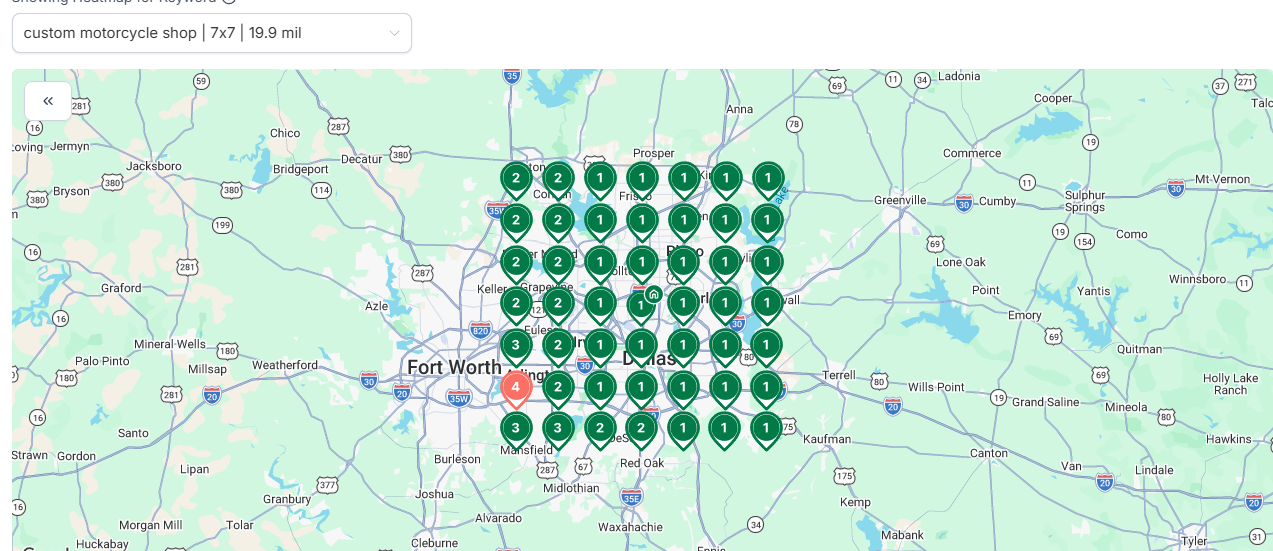
Strokers Dallas holds #1 across every grid position in DFW. They rank because of a YouTube channel, a bar, and a decade of brand links — not service SEO. One shop found the vacuum. Click to expand.
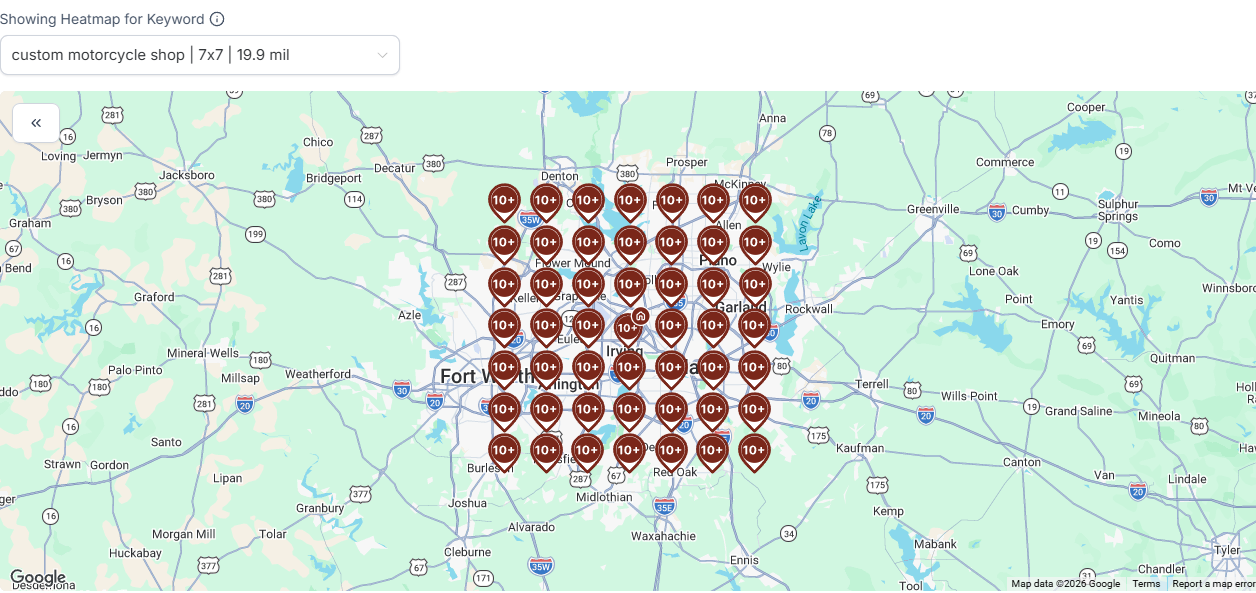
Metroplex Kustoms is the #2 organic result for this keyword in Dallas. Every pin is 10+. Ranked on Google's list — invisible in local search. This is what doing nothing produces. Click to expand.
Open an incognito tab. Search "custom motorcycle shop [your city]." The shop at #1 probably isn't a purpose-built service operation — it's a brand with a social following or a shop that accumulated links by existing long enough. The specific service searches — "Harley stage 3 tune [city]," "Indian suspension upgrade near me," "custom motorcycle exhaust [city]" — are completely uncontested in most markets. That's where the territory gets built.
Built for an Independent Shop. Not Adapted From a Dealership Template.
Every website tool built for motorcycle shops was designed with dealerships in mind — inventory management, OEM financing widgets, manufacturer co-op banner placements. Your shop isn't a dealership. You're a builder. A specialist. The place where riders go when the service department says "we don't do that."
The digital marketing infrastructure we build communicates what independent specialty shops actually do, to the buyers actually searching for it.
This isn't a fit for every shop. If your revenue runs entirely on referrals and you have no interest in growth, there are better uses of your money. If you're the best independent builder in your market and you're ready for the city to know it — this is what that infrastructure looks like.
The Harley Rider Who Just Moved to Your City Is Already Searching. Are You the Answer?
The organic searches in this vertical are specific. Not "motorcycle shop near me" — that's the Yelp category, and dealership service departments own it. The buyer looking for an independent specialist runs searches that filter for exactly what you do:
These aren't browsers. Someone searching "Indian Chief suspension upgrade Dallas" has a bike, a budget, and a decision to make. They are looking for a shop — specifically the kind of shop that does this work. A dealership page can't capture that search. A general auto shop can't capture it. A purpose-built specialty shop page can.
OTTO AI Optimization
Continuous on-page improvements running in the background — flagged for approval before publishing. The site improves every week without you managing it.
GBP as a Ranking Asset
Your Google Business Profile treated as a local search ranking lever, not a contact card. Structured, updated, and monitored monthly.
Competitive Monitoring
Monthly intelligence on every move your local competitors make — new content, new rankings, new keywords. You know what they're doing before they see results from it.
Managed SEO Content
Monthly page adds targeting new search positions — vehicle-specific content, service deep dives, and community pages that compound authority over time.
One Page on This Domain Is Worth More Than Any Ad You've Ever Run
When your shop joins the Osiris network, you get a dedicated profile on osirisautoguild.com — the Osiris-owned specialty automotive directory. One vetted shop per specialty per city. That is the consumer-facing function. The infrastructure function is what most shops never think about until they see it working.
The DFW Guild page is live and active. My Detail Guys — a founding network node, 17 years in business, 510+ Google reviews — has a dedicated external profile on osirisautoguild.com documenting every infrastructure change Osiris made and every result those changes produced. That profile is written by Osiris, from an external perspective, and links back to the shop. That is what Guild membership looks like at full execution.
The Guild is the consumer-facing face of the network. The network node program is how adjacent service shops plug into it, and how we manage every client's infrastructure is what keeps the whole system performing.
Your Shop Already Earned This Revenue. Most of It Just Didn't Close.
Cruiser and touring buyers are high-ticket and deliberate. They research for months. They price out a full custom build over three conversations before they commit. Most shops in this vertical treat that cycle as normal — you wait, they come back when they're ready.
The problem isn't the buyer's timeline. It's the gap in your follow-up.
A Harley rider who gets a stage 3 quote from your shop and goes quiet for two weeks isn't gone. He's thinking. And if your shop doesn't follow up, his next search is "Harley tune [city]" — and he finds someone who responds first.
The Missed Call
A rider calls about a winter custom build. You're under a Softail. He hangs up after six rings. He's gone unless an automated text fires in 30 seconds. Missed call text-back captures the lead before he reaches the next result in his search.
The Dead Quote
A touring rider got your estimate on new suspension and a Vance & Hines exhaust. Great conversation. Then nothing from your side. Three weeks later he booked elsewhere. The 30-day resurrection sequence recovers 10–15% of quotes that would otherwise stay dead.
The After-Hours Inquiry
He spent Sunday night planning next season's build. Submitted a contact form at 9:52 PM. Your shop opened Monday with no response system. His second choice replied at 9:54 PM via automated text. 56% of new inquiries arrive after hours.
Big Networks Fail When They Try to Be Everywhere at Once. We're Not Doing That.
Every company that has tried to build something like this has made the same mistake: spread to as many cities as they can reach, sign one or two shops per city, and discover that a half-built network produces nothing for anybody. Referrals require volume. Volume requires a complete network behind it. A directory spread thin across twenty cities is just a list of shops who paid for a promise.
Osiris operates on a different rule: one complete region before touching the next one. The Texas Triangle is the first region. Dallas–Fort Worth, Houston, San Antonio, Austin — treated as one economic unit, because that is already how the market behaves. Customers, shops, and specialty automotive commerce move freely between those four cities in ways that don't respect city lines. The Osiris network formalizes what was already happening.
And the execution reality: every DFW prospect can be called in a week. While those calls are working through the pipeline, Houston outreach begins. While Houston is in motion, San Antonio and Austin follow. The cities are worked in parallel because the outreach cadence allows it — and because artificial sequencing within a region that already has economic ties serves no one.
The commitment: every anchor vertical and universal node category across all four Texas Triangle cities — 100% filled — before Osiris opens in another state. Not majority-filled. Not mostly done. Complete. After the Triangle is proved across multiple cities with different competitive conditions: other states.
This is the same territory and anchor model laid out in how Osiris works and the full vision behind the build — and the position it describes is the one explained in who the anchor is for.
- Treating the Texas Triangle as one region — DFW, Houston, San Antonio, Austin
- Working all four cities in parallel as the call cadence allows
- 100% anchor and node fill across the Triangle before any other state
- Building founding node proof in DFW before the anchor network opens
- Slots that fill stay filled — the design intent is a permanent partner, not a revolving door
- Opening another state before the Triangle is complete
- Opening city Guild pages before the anchor pipeline backs them
- Signing anchor clients we haven't vetted
- Treating a few clients in each city as a network — it isn't one
The proof is already live. Two founding network nodes — My Detail Guys and My Upholstery Guys, Dallas–Fort Worth, inside the Osiris network since 2025 — produced 48% gross revenue growth, doubled full-time headcount, and 73 new Google reviews in 8 months. That happened before the first anchor vertical ever signed in DFW. Infrastructure alone did that. The anchor network and referral layer activate on top of that foundation.
That infrastructure was built by an operator who came up in the specialty trades, not in marketing — the Osiris story.
What Shop Owners Ask Before They Sign
Most agencies were built for general service businesses — or for dealerships with manufacturer co-op budgets and OEM support programs. Osiris builds exclusively for independent specialty shops. The SEO architecture targets the searches your buyers actually run. The website copy speaks the language of the vertical — stage tunes, custom builds, suspension work, exhaust installs. The CRM is calibrated for high-ticket, relationship-driven sales cycles, not repair order volume. And we operate on territorial exclusivity: one anchor per vertical per market. Your investment doesn't fund a competitor's infrastructure.
The complete breakdown of what that exclusivity position includes — territory lock, full-stack infrastructure, quarterly war room sessions, and the full niche architecture for this vertical — is at The Anchor Position.
Revenue growth in this vertical has two drivers: capturing displaced riders who just moved to your market and are starting a Google search from scratch, and recovering the revenue already in your pipeline that dies from lack of follow-up. The Osiris stack addresses both. SEO infrastructure captures first-contact searches from buyers who have no existing shop relationship. CRM automation recovers the quotes, missed calls, and after-hours inquiries your shop is already generating but not closing.
The highest-margin work in this vertical — full custom builds, stage 3 tunes, premium suspension overhauls, custom paint — requires trust before the buyer commits. Trust is built through authority signals: a site that communicates competence, a build gallery that shows the quality of your work, and a follow-up system that demonstrates you're serious. Shops that project authority charge more and close more. The infrastructure is the lever that builds that authority in your market.
The highest-value customer acquisition channel in this vertical isn't advertising — it's organic search. The Harley rider who just moved to your city and searches "custom Harley shop [city]" is pre-qualified, high-intent, and ready to commit to a shop relationship that will last years. A single acquisition like that generates lifetime value that advertising would never justify at cost. The infrastructure we build puts your shop in that search position.
Growth in a relationship-driven vertical follows a compounding pattern. The first three clients who find you through search become the referral network. The build showcases on your website become the social proof that converts the next wave. The follow-up system converts the leads your growing reputation generates but can't currently close. Each layer builds on the one before it. The shops that put this infrastructure in place early compound faster than the shops that wait.
The core SEO architecture for this vertical is platform-specific service pages indexed around the searches buyers actually run: "Harley Road Glide stage 3 tune [city]," "Indian Chief suspension upgrade near me," "custom motorcycle exhaust [city]." Paired with a Google Business Profile treated as a ranking asset — not a contact card — and authority signals from rider communities, club partnerships, and build content, this architecture competes in search positions no dealership service department is built to occupy. That's the gap. That's where the territory gets built.
One Shop Per Market. Yours or Someone Else's.
The cruiser and touring vertical operates on territorial exclusivity. One anchor shop per vertical per territory. Once that position is filled, it is filled — no competing shop in your market gets the same search infrastructure for the same vertical.
CRM infrastructure is not territory-exclusive. Any shop in any market can access the full operational stack regardless of territory status. But the SEO anchor — the website, the managed search presence, the local competitive lock — goes to one shop.
The anchor position in your city may be open. It may not be. The only way to know is to check.
Request Received
We'll check availability in your market and follow up within one business day. If your territory is open, we'll schedule a conversation. If it's filled, you'll be first on the notification list — and CRM access is available regardless of territory status.
Close