
Off-Road
Lead Generation.
A real off-road lead generation campaign isn't one channel. It's GBP, organic SEO, and paid ads running together — each doing the job the other two can't.
Off-Road Lead Generation Isn't One Channel.
Most Shops Only Run One.
Most off-road shops are running some version of lead generation. The problem is almost always the same: they've invested in one channel, that channel is doing the job it was designed to do, and the majority of the leads it should be generating are still going somewhere else. Not because the channel is wrong. Because the other two channels aren't running.
Off-road lead generation has three distinct buyer types at three distinct stages of decision — and each one needs a different channel to capture them. Running one in isolation means you're winning one buyer and losing the other two to shops that happened to build the other infrastructure first.
The Website Nobody Finds
The site exists. The agency said it was SEO-optimized. Three years later it ranks on page six for every query that matters. No GBP management. No paid coverage. The buyer who's never heard of the shop never finds it — because there's no mechanism connecting the site to a buyer who didn't already know to look.
The Abandoned GBP
The Google Business Profile was claimed at launch, photos added once, reviews getting replies. No posts. Wrong categories. No build-work photos. The profile Google is supposed to treat as a living signal has been static for two years. The competitor with fewer reviews is winning the map pack because they post every week.
Ads With No Organic
The shop has been running Google Ads for years. The ROAS looks acceptable. The question nobody asked: what happens when the budget turns off? If the answer is "all the leads disappear," the shop is renting attention it should own. Every dollar spent on a keyword with no organic ranking is paying for visibility that evaporates the moment the card is declined.
The channels are not interchangeable — and none of them work as well in isolation as they do running together. GBP captures the transactional buyer in the map pack. Organic content captures the research-phase buyer who reads before they call. Paid ads cover the gaps while the first two are still climbing. A shop running any one of them without the other two is winning one buyer type and losing the rest to whoever built the complete system first.
The complete picture of what territorial exclusivity means for the off-road anchor position — how the slot works, what the infrastructure includes, what the competition looks like when you move first — is at The Anchor Position.
Your Google Business Profile Is the One
"Social Media" Google Actually Ranks.
Most shops treat the Google Business Profile like a Yellow Pages listing — claim it once, answer reviews occasionally, and assume it's doing its job. Google treats it as a living content signal. The profile that posted twice this week outranks the profile that hasn't posted in two months, all else being equal. Google is measuring engagement, freshness, and category completeness — not just star count and review volume.
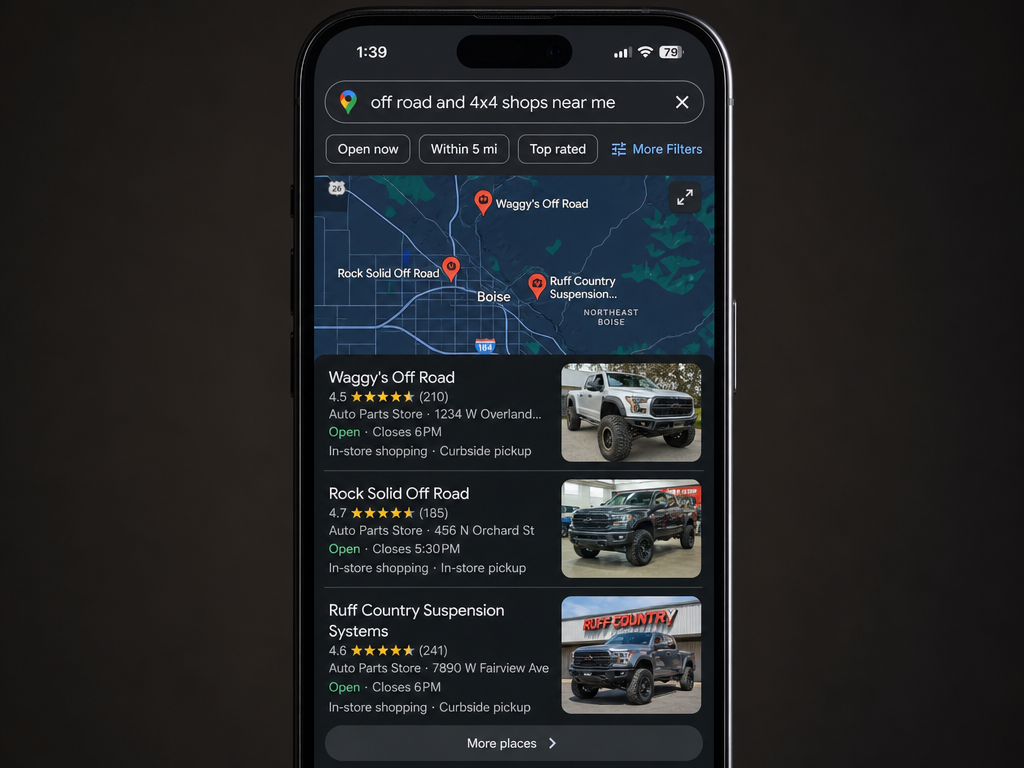
The map pack is where most local buyers start and end their decision for the fast, transactional services. Not on the website — they never get that far. A buyer searching "off road shop near me" or "4x4 alignment [city]" is making a decision from the three pins Google shows them. Proximity, star rating, review volume, and whether the profile looks like an active business or a ghost. The website never enters the picture. If the GBP isn't winning that moment, the shop is invisible for those transactions.
For the high-frequency, high-margin services that require less buyer commitment — quick installs, alignments, diagnostics, leveling kits, fast-turn work — the map pack is the entire sales funnel. Buyer searches → sees pins → checks stars and recent photos → calls the best one. The shop with the most credible, most active profile wins that call, regardless of which shop does the best actual work.
Osiris manages the GBP as an active publishing platform: weekly posts targeting the services and queries most relevant to the shop's map-pack goals, category optimization for the specific work you want ranked, photo rotation of actual shop builds and installed work, Q&A population with the questions buyers ask before they call, and a consistent review generation strategy — not just replying, but building the volume and recency Google uses to rank profiles against each other.
The GBP is also the fastest channel to see results from. A neglected profile that's actively managed for 60 days typically shows measurable map-pack position improvement before any organic page has climbed or any ad campaign has compounded. It is also the lowest-cost channel per lead of the three — and the one most shops are doing the least with.
Categories, attributes, service menus, weekly posts, Q&A populated with the questions your buyers actually type — and the photo strategy that shows Google you are a 4x4 specialist, not a generic auto shop. GBP optimization for off-road shops is category-specific work, not a generic local SEO checklist.
Off-Road Shop SEO: Content Builds
That Own the Research-Phase Buyer.
The build buyer doesn't search "off road shop near me" and call the nearest pin. They search "Jeep JL 3.5 inch lift kit installation near me," read three sites, compare, and call the shop whose content made them feel the most confident about the work. That is a completely different buying behavior — and it requires completely different infrastructure to capture.
For the considered, high-ticket purchase — lift kit, full build, suspension, armor package — the buyer researches before they buy. The decision cycle is not forty seconds in the map pack. It is two hours of reading, comparing, and qualifying shops against each other before a single call is made. The shop that wins that process is not necessarily the closest or the cheapest. It is the one that showed up in the research with the most specific, most credible content for that buyer's exact question.
Organic off-road shop SEO builds the page architecture that's present when that research happens. Vehicle platform pages that speak directly to the Wrangler buyer, the Tacoma owner, the Bronco owner. Service-depth pages targeting the specific installation and build queries your buyers actually use. Vehicle-plus-service combinations — "Jeep Wrangler JL 3.5 lift kit [city]" — that target the buyer who's already decided on the modification and is now deciding on the shop. Each page earns its ranking by being the most specific, most useful answer to the search it's built around.
This is the structural counterweight to GBP. The map pack wins the transactional buyer who chooses fast. Organic content wins the high-ticket buyer who researches before they call. A shop with a dominant GBP and weak organic presence is winning the quick-install work and losing the builds. A shop with strong organic rankings and a neglected GBP is winning the build buyer and losing the fast-turn work to whoever shows up in the map pack first. Both matter. They serve different buyers. The strategy has to serve both.
Two new pages go live every month. The AI SEO Pixel grades every existing page against real search data and queues optimizations. Competitor content is monitored — what queries they target, what pages they build. Every move in the territory is tracked and planned against.
A page that ranks today costs the same monthly whether it generates one lead or forty. As domain authority and content depth grow, the cost per lead from organic search falls every month — the opposite of paid ads, where the cost per lead is fixed or rising. This is the durable asset the faucet metaphor points toward.
Paid Ads Are the Faucet. We Turn Them On
Where You're Weak, Down As Organic Takes Over.
Paid search is the fastest path to visibility for any query the shop doesn't own organically. On day one of a campaign, the shop can buy the top-of-page position for "Jeep lift kit [city]" with zero organic ranking for that query. That is the function ads serve: immediate attention while GBP and organic are still compounding. The buyer sees the ad, clicks, and calls. The lead is real and the money is well-spent — while the shop has no other way to reach that buyer.
The operative word is while.
A shop that has been running Google Ads for three years with no parallel organic build has paid for attention three thousand times and owned it zero of them. Every click was bought. Every day the budget runs, the shop pays for that position. Turn the budget off — for any reason, budget cut, agency change, card issue — and the traffic disappears immediately. There is no residual asset. That is not a lead generation system. That is a lead generation subscription. The distinction matters when the budget gets compressed.
Full paid footprint while SEO and GBP are in the compounding phase. Every query that matters is covered by paid until organic earns it.
Budget migrates to the remaining gaps. The queries organic owns, it owns for free. Paid spend shrinks as coverage compounds. This is the direction the budget is always moving.
The goal is always to reduce the paid footprint over time, not expand it. A growing ad budget with no organic compounding behind it is a sign the strategy isn't producing what it should. A shrinking ad budget because the organic is taking over position after position is a sign it is. Osiris structures every paid campaign with an explicit exit plan — ads phase down as organic earns the ground, and the freed budget moves to the next gap until there are no gaps left to cover.
How GBP, SEO, and Paid Ads Run as One
Off-Road Lead Generation Campaign.
Each channel has a defined job and a defined buyer. They are not interchangeable, and they are not competing priorities. The reason most single-channel approaches underperform is not that the channel is wrong — it is that each channel only captures one type of buyer, and off-road lead generation has at least three.
Win the Map Pack
High-frequency / transactional. Decides in the map pack, never reads the site.
"off road shop near me," "4x4 alignment [city]," "leveling kit install near me"
30–90 days of active management to map-pack prominence
Lowest cost per lead of the three channels when managed consistently
Own the Research Phase
High-ticket / considered purchase. Researches for hours before calling. $3,000–$15,000 job.
"Jeep JL lift kit installer [city]," "long arm suspension shop," "overlanding build shop"
60–180 days to meaningful organic ranking; compounds indefinitely
Cost per lead falls every month as domain authority and page depth grow
Cover the Gaps
Any buyer, any query — anywhere organic and GBP don't yet have presence.
Every high-value query the shop can't yet reach organically or in the map pack
Immediate. Day-one impressions, day-one clicks, day-one leads.
Fixed or rising cost per lead; phases down and is replaced by organic as coverage matures
Together, these three channels make a comprehensive off-road lead generation campaign that doesn't depend on any single channel to keep leads flowing. GBP manages the map pack. Organic content claims the research buyer. Paid ads front-load attention on every query the organic hasn't earned yet. Each one is calibrated against the other two — the GBP posting reinforces the same service categories the organic is being built around, and the ad budget migrates as organic coverage expands. One campaign. Three instruments. One accountability structure.
The same infrastructure, the same territory logic, and the same accountability that governs every other vertical in the network is outlined in how Osiris works and who the anchor position is designed for.
One Page on This Domain Is Worth More Than Any Ad You've Ever Run
When your shop joins the Osiris network, you get a dedicated profile on osirisautoguild.com — the Osiris-owned specialty automotive directory. One vetted shop per specialty per city. That is the consumer-facing function. The infrastructure function is what most shops never think about until they see it working.
The DFW Guild page is live and active. My Detail Guys — a founding network node, 17 years in business, 510+ Google reviews — has a dedicated external profile on osirisautoguild.com documenting every infrastructure change Osiris made and every result those changes produced. That profile is written by Osiris, from an external perspective, and links back to the shop. That is what Guild membership looks like at full execution.
The Guild is the consumer-facing face of the network. The network node program is how adjacent service shops plug into it, and how we manage every client's infrastructure is what keeps the whole system performing.
Lead Generation Without Lead Capture
Leaks Revenue.
Three channels generating inbound leads creates a new problem: the same volume that justifies the investment exposes the same revenue leaks that exist in every specialty shop that hasn't automated its capture layer. The missed call at 2PM while the shop is heads-down on a build. The after-hours inquiry that went unresponsive until 9AM. The quoted job that died at three days of silence because nobody had time to follow up.
The faucet-to-bucket problem: you can turn the faucet all the way on, but if the bucket has holes, you are not filling it faster — you are flowing more water over the same leaks. Lead generation investment amplifies whatever happens at the point of capture. A strong capture system means more revenue from the same spend. A weak capture system means more spend required to maintain the same revenue — because you are losing a growing percentage of what the investment generates, and compensating with volume instead of fixing the holes.
The Osiris CRM closes both gaps. Missed-call text-back fires within 60 seconds of any hung-up call — recovering the lead before they reach the next Google result. After-hours handling captures contact information from buyers who searched at 10PM and called expecting to leave a message. Post-quote follow-up runs on a structured automatic cadence — because no shop has the bandwidth to manually chase every estimate that goes out, and the ones that don't are losing those jobs to the shop that does.
The average repair order at a specialty 4x4 shop is $913. The average lifetime value of a single acquired customer exceeds $2,000. When a lead that one of your three channels generated goes unanswered, you are not losing a transaction — you are losing the repeat builds, the referrals, the customer who would have brought their trail club. The CRM does not generate demand. It stops the demand you are already paying to generate from leaking out through the same holes that have always been there.
Big Networks Fail When They Try to Be Everywhere at Once. We're Not Doing That.
Every company that has tried to build something like this has made the same mistake: spread to as many cities as they can reach, sign one or two shops per city, and discover that a half-built network produces nothing for anybody. Referrals require volume. Volume requires a complete network behind it. A directory spread thin across twenty cities is just a list of shops who paid for a promise.
Osiris operates on a different rule: one complete region before touching the next one. The Texas Triangle is the first region. Dallas–Fort Worth, Houston, San Antonio, Austin — treated as one economic unit, because that is already how the market behaves. Customers, shops, and specialty automotive commerce move freely between those four cities in ways that don't respect city lines. The Osiris network formalizes what was already happening.
And the execution reality: every DFW prospect can be called in a week. While those calls are working through the pipeline, Houston outreach begins. While Houston is in motion, San Antonio and Austin follow. The cities are worked in parallel because the outreach cadence allows it — and because artificial sequencing within a region that already has economic ties serves no one.
The commitment: every anchor vertical and universal node category across all four Texas Triangle cities — 100% filled — before Osiris opens in another state. Not majority-filled. Not mostly done. Complete.
This is the same territory and anchor model laid out in how Osiris works and the full vision behind the build — and the position it describes is the one explained in who the anchor is for.
- Treating the Texas Triangle as one region — DFW, Houston, San Antonio, Austin
- Working all four cities in parallel as the call cadence allows
- 100% anchor and node fill across the Triangle before any other state
- Building founding node proof in DFW before the anchor network opens
- Slots that fill stay filled — the design intent is a permanent partner, not a revolving door
- Opening another state before the Triangle is complete
- Opening city Guild pages before the anchor pipeline backs them
- Signing anchor clients we haven't vetted
- Treating a few clients in each city as a network — it isn't one
The proof is already live. Two founding network nodes — My Detail Guys and My Upholstery Guys, Dallas–Fort Worth, inside the Osiris network since 2025 — produced 48% gross revenue growth, doubled full-time headcount, and 73 new Google reviews in 8 months. That happened before the first anchor vertical ever signed in DFW. Infrastructure alone did that. The anchor network and referral layer activate on top of that foundation.
That infrastructure was built by an operator who came up in the specialty trades, not in marketing — the Osiris story.
Off-Road Shop Lead Generation —
Six Questions Before the First Call.
Off-road lead generation runs on three channels — Google Business Profile for the map pack, organic SEO for the research-phase buyer, and paid ads covering the gaps until the other two are ranking. Each channel captures a different buyer type at a different stage of their decision.
The GBP wins the transactional buyer who searches "off road shop near me" and calls the best pin. Organic content wins the buyer who's been thinking about a lift kit for months and is now comparing shops by reading websites. Paid ads capture any buyer searching a query the shop doesn't yet rank for organically or in the map pack.
Together, they form a campaign that isn't dependent on any single channel. When one compresses — a map-pack position shifts, an organic page gets outranked, a paid budget gets cut — the other two are still generating. That structural redundancy is what separates a real off-road lead generation campaign from a single-channel dependency.
Not forever — but very likely at the start. Organic SEO takes 60–180 days to produce meaningful rankings on competitive queries. Paid ads provide immediate coverage for every query the shop doesn't yet rank for. If the shop has no organic presence for "Jeep lift kit [city]" today, paid ads capture that buyer right now while the SEO builds toward that position.
As organic pages climb into rankings and hold them, the ad spend on those queries phases down. A shop 18 months into an organic build with strong coverage across its target queries typically runs a much smaller paid footprint than it did on day one — because organic is now capturing most of the search territory the ads used to buy.
The goal is always to shrink the paid footprint over time, not grow it. A growing ad budget with no organic compounding behind it is a sign the strategy isn't producing what it should. Ads are not the destination. They are the bridge.
For a large portion of local searches, the website is never visited. Buyers searching "off road shop near me" or "4x4 alignment [city]" are making their decision from the map pack — three pins with a star rating, a phone number, and recent photos. If the GBP isn't one of those three pins, the website doesn't matter for that search because the buyer never gets that far.
The GBP is the front door for transactional, high-frequency local searches. A strong website with a neglected GBP wins the buyer who already knows the shop's name and is looking it up to confirm the number. A strong GBP wins the buyer who has never heard of the shop and is choosing right now from the map pack. Those are different buyers, reached by different infrastructure.
Most shops have put significant investment into their website and almost none into their GBP beyond claiming it. The GBP is often where the faster, cheaper, and most immediate lead volume lives — particularly for the fast-turn, high-margin services that don't require a long research cycle.
Map-pack leads are transactional — the buyer searched, picked from pins, and called. They chose by proximity, star rating, and visible credibility. Their decision cycle is short: often under a minute between the search and the call. These leads are typically looking for something with less buyer friction — a quick install, an alignment, a diagnostic, a leveling kit.
Website leads are typically higher-ticket and further into a research process. The buyer clicked through from an organic result, read the page, assessed the shop's credibility, and called because the content made them confident. They are more likely to be inquiring about a full build or a complex multi-component install. Their decision cycle is longer — sometimes days — and their job value is typically $2,000–$10,000 or more.
Both matter. A shop that only wins map-pack leads is doing a lot of fast-turn work and missing the builds. A shop that only wins organic/website leads is doing the high-ticket jobs but losing the quick, consistent revenue the map pack generates. The complete off-road lead generation campaign captures both.
The first organic rankings typically appear within 60–90 days for lower-competition queries — suburb-plus-service combinations, long-tail vehicle-plus-modification queries. Core metro queries for competitive services like "Jeep lift kit [city]" take 90–180 days to climb meaningfully. As pages rank and hold positions, the ad budget targeting those specific queries phases down proportionally.
A shop that starts with full ad coverage and no organic ranking can typically reduce paid spend by 30–50% in the first six months as organic pages claim those positions in competitive markets. The transition is gradual — ads never phase down on a query the organic isn't actively holding. The budget migrates to the remaining gap queries until there are no gaps left to cover.
The key variable is competitive density. A shop in a market with no competing organic content climbs faster. A shop competing against a well-built competitor site climbs against existing authority. Either way, the trajectory is always toward smaller paid footprint — and that trajectory starts on day one of the organic build, not six months in.
Together — that is the point. A GBP managed separately from SEO doesn't know what queries the organic is ranking for and can't calibrate its category targeting to reinforce the same service signals. An ad campaign run separately from SEO burns budget on queries the organic could own for free with another month of compounding — because no one is tracking what's ranking and adjusting spend accordingly.
The three-channel approach produces its full return only when the channels are calibrated against each other: ad spend phasing down as organic pages take over positions, GBP posts reinforcing the same service categories the organic is being built around, and competitive intelligence from all three channels feeding into one territory map updated monthly.
Osiris manages all three as one campaign, one territory, and one accountability structure. There is no separate GBP vendor, separate SEO agency, and separate paid-ads manager working from different dashboards. One system, one view of the territory, one place where the handoff between paid and organic is tracked and executed.
One Shop Per Market.
One Territory Per Vertical.
Osiris operates on territorial exclusivity. One anchor client per off-road vertical per metro territory. When a slot is filled, it stays filled. No competing 4x4 shop in your market receives the same three-channel infrastructure — GBP, organic SEO, and paid ads — managed as one campaign from one accountability structure.
If your market has an open anchor slot, the conversation starts now.
If your market is filled, the CRM is available immediately — there is no territorial restriction on the operations layer. The waitlist governs the SEO and map-pack anchor position, not the automation infrastructure. Start recovering the leads your shop is already generating while the anchor slot opens. When it does, you are already in the system and already ahead.
See If Your Territory Is Available →Off-Road Lead Generation — Markets We Serve
One anchor per vertical per metro. Click your market to see how the off-road lead generation infrastructure is built for your specific territory — GBP management, organic content architecture, and paid gap coverage calibrated to your competitive map.
Texas Triangle — Active Markets Expansion Markets