
Diesel Performance Shop Marketing in Atlanta. The Repair Shop Is Ranking. That Gap Is Yours.
"Diesel performance shop Atlanta" looks contested. It isn't. Every result ranking for that keyword is a diesel repair operation that added "performance" somewhere in its description. None of them built for the performance buyer. The first shop that does won't compete for that position — it will own it. Atlanta is the diesel hub of the Southeast, and the performance position across the metro is wide open online.
Atlanta Has Diesel Shops. It Doesn't Have a Diesel Performance Shop Online.
The diesel performance buyer has done more research than most shops give him credit for. He knows the difference between a canned tune and a custom EFI Live file. He knows what the stock CP3 can handle and where it fails. He knows what breaks first when you push a stock drivetrain past 600hp. He's been in forums, watched build videos, and priced out the sequence before he ever contacts a shop.
What he's looking for when he searches is the shop that knows what he knows — and can prove it before he calls.
Right now in Atlanta, that shop doesn't exist online. The results ranking for "diesel performance shop Atlanta" are diesel repair operations — more reviews, more GBP history, more domain authority, earned on service work, not on tuning, fuel, and turbo builds. As the largest metro in the Southeast, Atlanta anchors a deep truck culture across North Georgia — heavy towing, year-round wrenching, and trucks that get built and kept. The performance buyer pool here is one of the biggest in the region, and no shop has built the site that speaks to it.
That gap is the whole business case. The performance buyer is out there. He just can't find the right shop. And the right shop — yours — isn't showing up for him.
Diesel Performance SEO: The Position Is Less Contested Than the Keyword Suggests
Open a new browser tab. Search "diesel performance shop Houston."
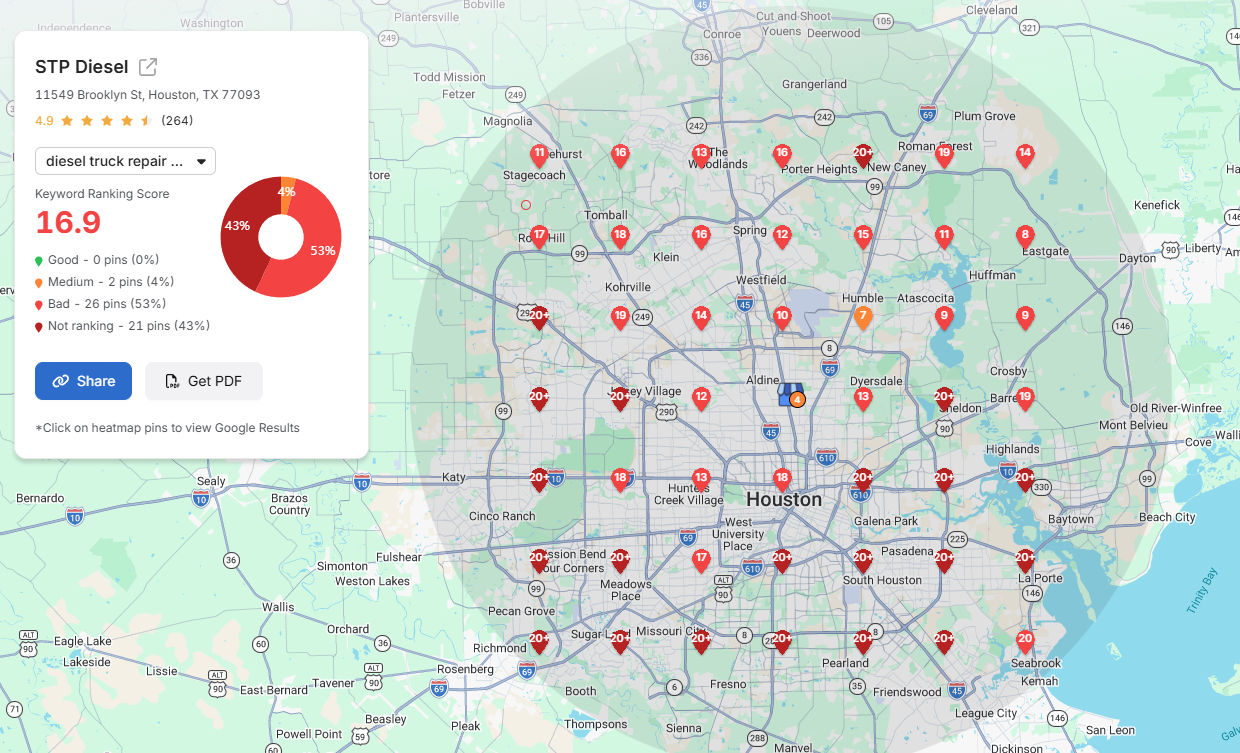
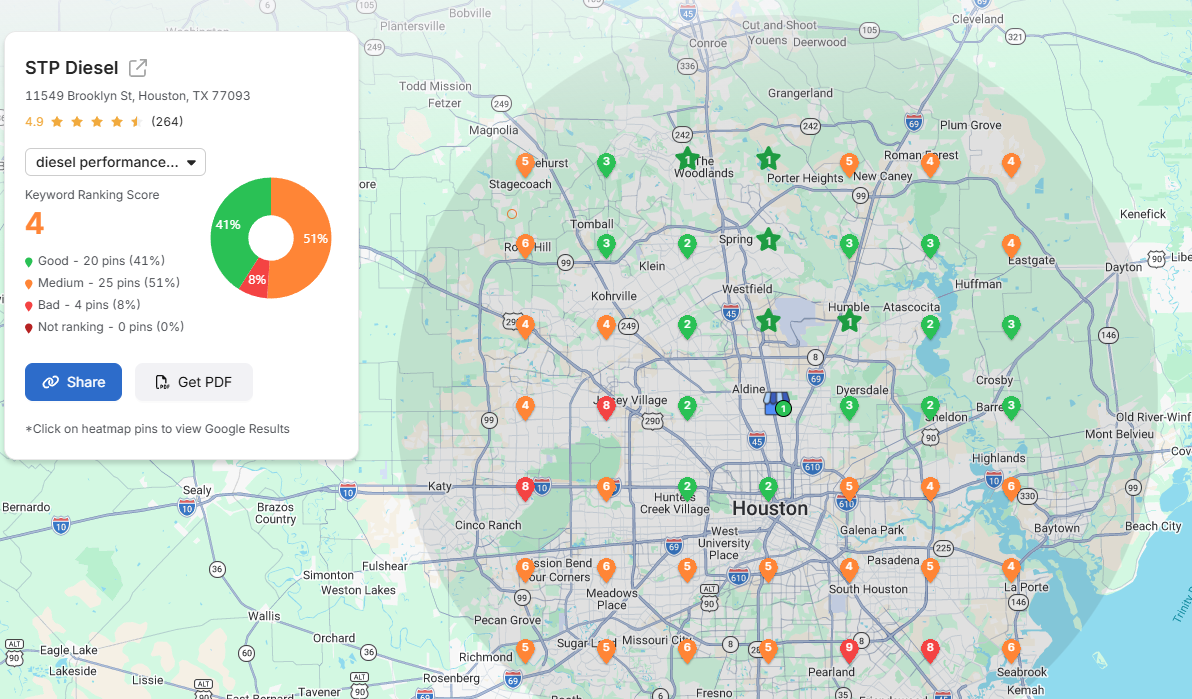
The #1 result is STP Diesel. The #2 result is PSP Diesel. Both are legitimate operations — established, well-reviewed, with real heatmap presence across the metro. These aren't fly-by-night listings. They've put in the work on the repair side and it shows.
Now click through and look at the sites. Find the Cummins-specific build page. The Power Stroke performance page. The Duramax compound turbo page. The EFI Live tuning content. The dyno gallery with before-and-after horsepower and torque numbers. The competition prep page. The build showcase.
You'll be looking for a while. Across the top two results in the largest diesel truck market in the country, 95% of the service content is repair and replace — not performance. These shops rank for "diesel performance shop Houston" because they've built diesel authority over years, not because they've built performance infrastructure. The keyword doesn't know the difference. The performance buyer does.
Now look at the top of the page. Google isn't even surfacing a map pack for this keyword. No 3-box. No proximity advantage. No GBP shortcut. "Diesel performance shop Houston" is classified as a content authority query — meaning the only thing that determines who ranks is what's on the website. And sitting above the organic results is an AI Overview summarizing the top shops and calling them diesel performance options. Every shop it cites — PSP, STP, Longhorn — is described in repair terms because that's all their content supports. That AI slot is a citation position. It goes to whoever builds the content that earns it.
The digital marketing position for diesel performance in Houston isn't contested. It's unclaimed. There's no map pack to fight for, no incumbent with a performance-built site, and an AI Overview actively looking for something worth citing. That is the opening. If it exists in the largest diesel market in the country, it exists in Atlanta.
You got into diesel to build. You already know what your calendar looks like — oil changes, DEF system repairs, warranty work that keeps the lights on. You take repair jobs because you have to, not because you want to. The performance buyers who should be filling that calendar with custom tunes, fuel system builds, and compound setups aren't finding you. They're finding the repair shop with more reviews from 2019.
When you own "diesel performance shop Atlanta" organically, the repair work becomes optional. You close the builds you got into this for. You take repair when you choose to — not because it's all that's coming in.
Repair is your foundation. You're not losing the performance market — you never went after it. But here's how it's actually playing out for the buyer who wants what you're capable of building.
He searches "diesel performance shop Atlanta." Finds the same two or three diesel repair shops every search returns. Clicks through, does his homework, figures out they're repair shops that also do some performance. Goes back to the results. Scrolls past the forums. Scrolls past the aggregators. Eventually finds the small shop that actually IS a performance operation — three bays, one guy who knows exactly what he's doing — and then lands on a GoDaddy website the owner built on a Sunday afternoon. No dyno sheets. No build showcase. No evidence that they've done the job he needs done.
He's looking at spending $10,000 to $30,000 on a truck worth twice that. He is not handing those keys to a shop that won't spend $3,000 on a website. If you're not serious about your own presentation, why would he believe you're serious about his build?
So he goes back to the top of the list. He calls the repair shop with the reputation. Not because they won. Because at least they have a reputation to lose.
You're closing that buyer — but not because you earned it. He came in frustrated, already settling. That buyer haggles. That buyer second-guesses. That buyer doesn't refer the next guy.
The digital marketing infrastructure changes what you're winning. The buyer who finds you through a platform page, a build showcase with real dyno numbers, a compound turbo page written by someone who knows what a compound setup actually involves — that buyer isn't settling. He chose you. Those two buyers are not the same customer. They don't spend the same, they don't refer the same, and they don't come back the same.
You don't have to give up a single repair bay. You just have to show up online the way your shop shows up in person.
Diesel Performance Shop Marketing Built for Cummins, Power Stroke, and Duramax Builders
The diesel performance buyer researches before he calls. He's reading platform-specific pages, looking at dyno numbers, checking whether a shop has built the configuration he's planning. Drop Forged Diesel is Osiris's diesel performance demo site — gunmetal build, forge-red accents, platform-fluent copy written for the buyer who already knows the difference between a CP3 conversion and a lift pump upgrade.
- Engine Tuning & ECM Programming — custom EFI Live vs. mail-order framing, tow tune vs. performance tune
- Fuel System Upgrades — injectors, lift pumps, CP3 conversions, FASS, AirDog
- Turbo & Forced Induction — compound setups, big singles, upgraded turbos
- Diesel Lift Kits & Leveling — diesel-specific, torque failure calculus above threshold power
- Wheels & Tires — load ratings, dual fitment, aggressive MT for working trucks
- Ram 2500/3500 — Cummins platform page, 6.7 and 5.9 specific language
- Build Process — consultation to dyno; trust builder for high-ticket buyers
- Gallery with Dyno Sheets — before/after HP and torque numbers, competition results
- Contact — phone capture on every form; no email-only paths
- F-250/F-350 — Power Stroke platform page, 6.7 and 6.4 specific, known failure points
- Silverado/GMC Sierra 2500/3500 — Duramax platform page, L5P/LML/LBZ distinction
- Exhaust Systems — DPF-back, turbo-back, performance mufflers
- Intercooler Upgrades — standalone search intent, core power adder content
- Transmission Upgrades — Allison, 48RE, 68RFE, 6R140 failure framing
- Cooling System Upgrades — EGTs, coolant delete kits, upgraded radiators
- Emissions Policy page — liability protection and trust signal in one page
- Towing Performance Package — the buyer pulling 40k who knows he's leaving HP on the table
- Competition & Sled Pull Prep — pulls the competition buyer before he calls a one-trick shop
- Build Showcase #1 — vehicle, mods, dyno numbers, photos
- Ram Cummins Compound Turbo Build — highest-intent query in diesel performance; buyer already decided
- F-250 Power Stroke Performance Tune & Fuel System deep dive
- Geo pages — Katy, Pearland, Sugar Land, The Woodlands, Humble, Baytown, Spring, Tomball
- Brand partner pages — ARP, Industrial Injection, FASS, Banks Power
- Build Showcases #2 and #3 — different platforms, different use cases
- Diesel Drag Prep — quarter-mile builds, index racing, distinct from sled pull
- Full blog infrastructure — content population begins with Managed SEO
- Diesel Community Hub — clubs, truck pull events, diesel nights, local trails
- Diesel Sled Pull & Competition Guide — event calendar, build requirements, class breakdown
The diesel performance buyer is doing his research before he calls. He will read the page. He will know if the shop that built it actually builds diesels or just wanted the keyword. Every page in every tier is written with enough technical fluency to pass that test — because the buyer is running it whether the shop realizes it or not.
Not every diesel shop is the right fit for this build. If performance is a line item on a repair menu, this infrastructure won't move the needle. If the performance side of your business is where you're going — or where it was always supposed to go — this is the infrastructure that makes that happen.
Diesel Performance SEO in Atlanta for the High-Intent Buyer Who Already Decided
The Atlanta diesel performance buyer who searches "Cummins compound turbo build Atlanta" isn't browsing. He knows what he wants built. He's looking for the shop that can prove they've done it. The search architecture Osiris builds is designed for that moment — not the moment before it.
Buyer Queries We Rank For
One anchor client per diesel performance vertical per market. When the slot in your city is taken, it is closed — not waitlisted, not re-evaluated. Closed.
OTTO Technical SEO
OTTO runs a continuous technical audit of your Osiris site — crawl errors, duplicate content, missing schema, page speed signals. The infrastructure that earns rankings stays clean so it keeps them.
Google Business Profile
GBP is treated as a second search surface, not an afterthought. Platform-specific categories, diesel-relevant attributes, build photos, review velocity. The buyer who searches on Maps finds the same shop that ranks on Search.
Competitive Monitoring
We track what the repair shops ranking above you are doing — when they add content, when their rankings shift, when a new shop enters the market. You hold an active position on the field, not a website that ranks until something changes.
Territory Lock
The anchor slot in your market is yours exclusively for as long as you're on the platform. No competitor can buy in. No second diesel performance anchor in your territory. The lock is structural — it's in the MSA, not just in the pitch.
The complete breakdown of what that exclusivity position includes — territory lock, full-stack infrastructure, quarterly war room sessions, and the full niche architecture for this vertical — is at The Anchor Position.
One Page on This Domain Is Worth More Than Any Ad You've Ever Run
When your shop joins the Osiris network, you get a dedicated profile on osirisautoguild.com — the Osiris-owned specialty automotive directory. One vetted shop per specialty per city. That is the consumer-facing function. The infrastructure function is what most shops never think about until they see it working.
The DFW Guild page is live and active. My Detail Guys — a founding network node, 17 years in business, 510+ Google reviews — has a dedicated external profile on osirisautoguild.com documenting every infrastructure change Osiris made and every result those changes produced. That profile is written by Osiris, from an external perspective, and links back to the shop. That is what Guild membership looks like at full execution.
The Guild is the consumer-facing face of the network. The network node program is how adjacent service shops plug into it, and how we manage every client's infrastructure is what keeps the whole system performing.
Powerstroke, Cummins, and Duramax Shop Marketing With Pipeline Infrastructure to Match
The diesel performance buyer reaches out to more than one shop. He buys from the first one that responds — not the best one, not the one with the most reviews. The first one. A diesel performance build is a $4,000 to $25,000 decision the buyer has been researching for weeks. He is ready. If your shop doesn't respond in under five minutes, he's already on the phone with the shop that did.
A shop responding in under 5 minutes is 21× more likely to close the lead than one that waits 30. Every web lead submitted through your Osiris site receives an automated text response in under 2 minutes — whether you're on the dyno at 4pm or under a truck at 8am. The consultation gets booked. The build gets closed.
The diesel performance buyer reads more reviews than most — he's vetting technical credibility, not just checking the star rating. A shop with strong performance-specific reviews earns the call before the shop with twice as many reviews for oil changes. The Osiris CRM triggers a review request after every completed job, automatically. Review count grows without adding a single task to your workflow.
The buyer who submitted a form and didn't hear back isn't gone. He's still in market — either waiting or about to give the job to someone else. The Osiris pipeline identifies every stalled lead and re-engages it automatically — a follow-up text at 24 hours, a second at 72. Most shops let these leads expire. Yours doesn't.
Big Networks Fail When They Try to Be Everywhere at Once. We're Not Doing That.
Every company that has tried to build something like this has made the same mistake: spread to as many cities as they can reach, sign one or two shops per city, and discover that a half-built network produces nothing for anybody. Referrals require volume. Volume requires a complete network behind it. A directory spread thin across twenty cities is just a list of shops who paid for a promise.
Osiris operates on a different rule: one complete region before touching the next one. The Texas Triangle is the first region. Dallas–Fort Worth, Houston, San Antonio, Austin — treated as one economic unit, because that is already how the market behaves. Customers, shops, and specialty automotive commerce move freely between those four cities in ways that don't respect city lines. The Osiris network formalizes what was already happening.
And the execution reality: every DFW prospect can be called in a week. While those calls are working through the pipeline, Houston outreach begins. While Houston is in motion, San Antonio and Austin follow. The cities are worked in parallel because the outreach cadence allows it — and because artificial sequencing within a region that already has economic ties serves no one.
The commitment: every anchor vertical and universal node category across all four Texas Triangle cities — 100% filled — before Osiris opens in another state. Not majority-filled. Not mostly done. Complete. After the Triangle is proved across multiple cities with different competitive conditions: other states.
This is the same territory and anchor model laid out in how Osiris works and the full vision behind the build — and the position it describes is the one explained in who the anchor is for.
- Treating the Texas Triangle as one region — DFW, Houston, San Antonio, Austin
- Working all four cities in parallel as the call cadence allows
- 100% anchor and node fill across the Triangle before any other state
- Building founding node proof in DFW before the anchor network opens
- Slots that fill stay filled — the design intent is a permanent partner, not a revolving door
- Opening another state before the Triangle is complete
- Opening city Guild pages before the anchor pipeline backs them
- Signing anchor clients we haven't vetted
- Treating a few clients in each city as a network — it isn't one
The proof is already live. Two founding network nodes — My Detail Guys and My Upholstery Guys, Dallas–Fort Worth, inside the Osiris network since 2025 — produced 48% gross revenue growth, doubled full-time headcount, and 73 new Google reviews in 8 months. That happened before the first anchor vertical ever signed in DFW. Infrastructure alone did that. The anchor network and referral layer activate on top of that foundation.
That infrastructure was built by an operator who came up in the specialty trades, not in marketing — the Osiris story.
Common Questions.
One Slot in Atlanta.
Check If It's Still Open.
Osiris signs one anchor client per diesel performance vertical per market territory. When the Atlanta slot is taken, it is closed — not waitlisted, not re-evaluated quarterly. The next shop to enter that market enters as a CRM-only client. They do not get the SEO build. They do not get the organic position. They do not get the territory lock.